


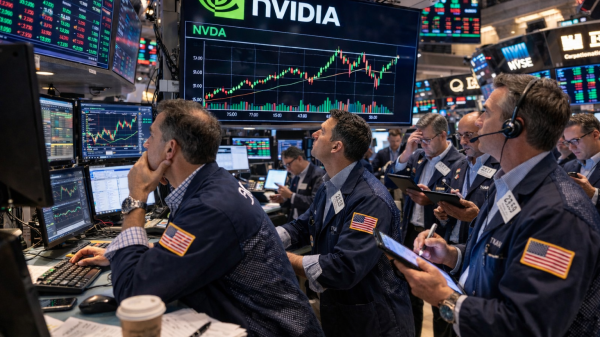









Nvidia stock remained under pressure early Wednesday as fresh reports from China cast further doubt on the company’s ability to resume sales of its H200 artificial intelligence chips to Chinese customers.
At the time of writing, the Nvidia stock was down around 2% to trade at around $181.
According to a report by Reuters, Chinese customs authorities this week instructed customs agents that Nvidia’s H200 AI chips are not permitted to enter the country.
In parallel, Chinese government officials summoned domestic technology companies to meetings on Tuesday, where they were explicitly told not to purchase the H200 chips unless doing so was strictly necessary, another report in The Information said.
“The wording from the officials is so severe that it is basically a ban for now, though this might change in the future should things evolve,” one of the people familiar with the discussions told the news agency.
H200 emerges as a geopolitical flashpoint
The H200, Nvidia’s second-most powerful AI chip, has become one of the most contentious issues in current US-China relations.
While demand from Chinese technology companies remains strong, Beijing’s intentions are far from clear.
Market participants are divided over whether China aims to impose an outright ban to accelerate the growth of domestic chipmakers, introduce narrowly tailored restrictions, or use the issue as leverage in broader negotiations with Washington.
The uncertainty is compounded by the fact that the Trump administration formally approved exports of the H200 to China this week, albeit under specific conditions.
The approval has itself proven controversial in the United States, where China hawks have warned that allowing such advanced chips into China could enhance the country’s military capabilities and erode America’s lead in artificial intelligence.
Conflicting signals from Beijing
Adding another layer of complexity, The Information reported on Tuesday that the Chinese government told some technology companies it would only approve H200 purchases under special circumstances, such as research and development projects conducted in partnership with universities.
That narrower allowance contrasts with the more sweeping tone described in the Reuters report, highlighting the fluid and opaque nature of Beijing’s decision-making.
Last year, President Donald Trump initially banned exports of Nvidia’s much weaker H20 chip before later allowing limited sales.
Beijing, however, effectively blocked those exports from around August, prompting Nvidia Chief Executive Jensen Huang to say the company’s share of China’s AI chip market had fallen to zero.
The H200 represents a far more consequential product. It delivers roughly six times the performance of the H20, making it a critical tool for large-scale training of advanced AI models.
While Chinese chipmakers such as Huawei have developed processors like the Ascend 910C, industry participants widely regard Nvidia’s H200 as significantly more efficient and mature for cutting-edge workloads.
High stakes for both sides
As per reports Chinese technology companies have placed orders for more than two million H200 chips, priced at about $27,000 each, far exceeding Nvidia’s current inventory of roughly 700,000 chips.
That demand illustrates the scale of the opportunity — and the tension — surrounding the product.
Whether Nvidia or China has more to gain from resuming H200 sales remains an open question.
For Nvidia, re-entry into the Chinese market would unlock tens of billions of dollars in potential revenue.
The US government would also benefit, having imposed a 25% fee on approved chip exports.
Supporters of exports, including White House AI czar David Sacks, have argued that selling advanced chips to China could discourage domestic rivals from accelerating efforts to catch up with Nvidia’s most sophisticated designs.
Critics counter that such sales risk strengthening China’s strategic capabilities.
The renewed restrictions appeared to benefit China’s domestic semiconductor sector.
Chinese chipmaking stocks rose on Wednesday after reports that Beijing would limit H200 purchases to exceptional cases.
Those gains were reinforced after Zhipu, one of China’s so-called “AI tigers,” unveiled a new AI model that it said was trained entirely on locally made chips developed by Huawei.
The announcement was widely interpreted as a signal of Beijing’s determination to promote homegrown alternatives to US technology.
The post Why Nvidia stock is down over 2% today appeared first on Invezz