

















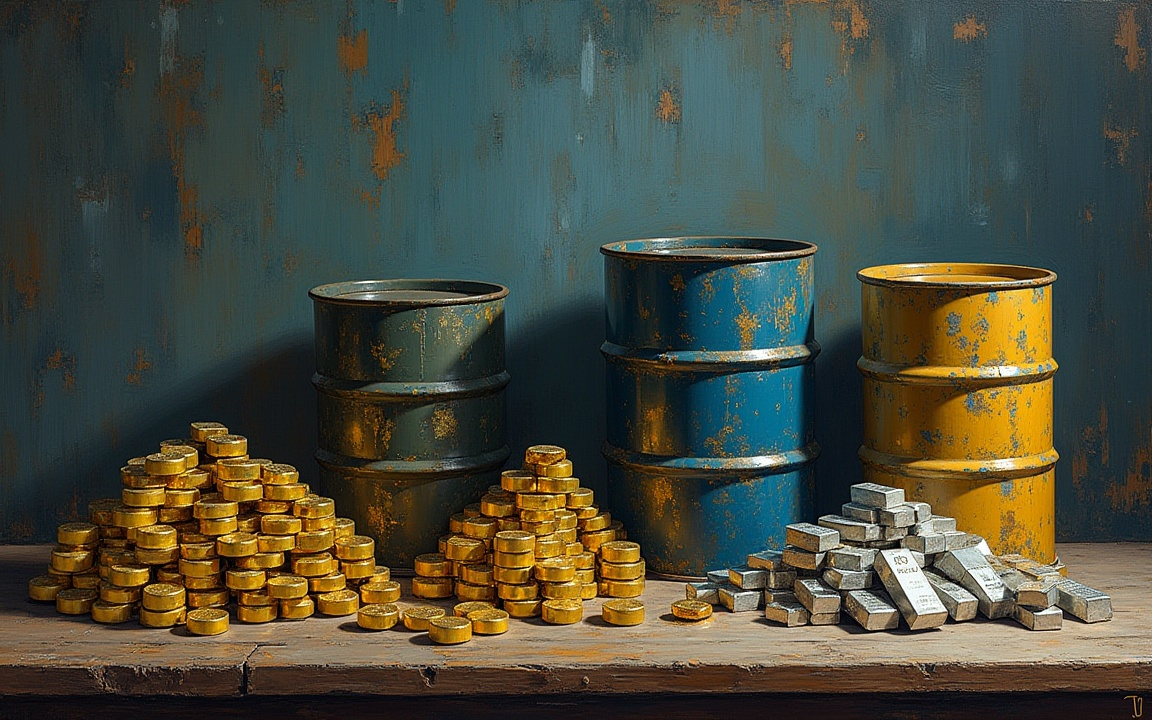
Gold prices slipped on Wednesday, but were on track for steepest annual gains since 1979.
Silver prices more than doubled in 2025 even as the white metal retreated sharply on the last trading of the year.
Meanwhile, the picture is quite different for crude oil. Oil prices were headed for its biggest annual decline since 2020.
Among base metals, copper prices also retreated on Wednesday, but were on course for its biggest annual gain since 2009. The rally in 2025 saw the metal hit a series of record highs.
At the time of writing, the three-month copper contract on the London Metal Exchange was at $12,473.15 per ton, down 1.3%.
Precious metals’ stellar 2025
Despite a Wednesday slip, precious metals are set for a phenomenal year of gains.
Silver and platinum prices have more than doubled, and gold’s record-high run has secured its strongest annual performance in over four decades.
Gold prices have seen an exceptional surge this year, climbing by approximately 65%—the sharpest annual increase since 1979.
This significant rally is primarily attributed to several factors: US interest rate cuts and anticipated further monetary easing, rising geopolitical tensions, substantial purchases by central banks, and strong inflows into Exchange-Traded Funds (ETFs).
Following CME’s decision to increase margins on precious metal futures, prices have decreased from their recent highs as traders engaged in profit-taking.
“The non-interest-bearing precious metals, including gold lose ground as the Federal Open Market Committee (FOMC) December Meeting Minutes, released on Tuesday, indicated a deeply divided committee,” Akhtar Faruqui, editor at FXstreet, said in a report.
After three rate reductions this year, some Federal Reserve (Fed) officials suggested maintaining the current rate level for a period.
Conversely, other policymakers believed that additional rate cuts would likely be warranted if inflation continued its downward trend.
Meanwhile, with a staggering year-to-date gain of over 145%, silver has significantly outperformed gold and is on track for its most successful year to date.
This robust rally is fueled by several factors, including supply shortages, historically low inventories, burgeoning industrial and investor demand, and its recent classification as a critical mineral in the US.
At the time of writing, the silver contract on COMEX was at $71.487 per ounce, down 8.3%, while gold was at $4,324 per ounce, down 1.4%.
Oil set for annual drop
Against the backdrop of concerns over supply disruptions and oversupply fears, oil prices rose on Wednesday, but are on track for an annual decline of over 15% in 2025.
This slump was fueled by a year dominated by geopolitical conflicts, elevated tariffs, OPEC+ output dynamics, and sanctions imposed on major producers, including Russia, Iran, and Venezuela.
Brent crude futures are set for a third consecutive year of losses—their longest losing streak on record—with a substantial annual percentage decline of nearly 18%, the most significant drop since 2020.
Similarly, US West Texas Intermediate crude is on track for an annual decline of 19%.
Jason Ying, a commodities analyst at BNP Paribas, forecasts that Brent crude will initially drop to $55 a barrel in the first quarter of 2026.
However, he expects a recovery, with the price stabilising at $60 a barrel for the remainder of the year.
This prediction is based on the expectation that supply growth will normalise while demand remains unchanged.
“The reason why we’re more bearish than the market in the near term is that we think that US shale producers were able to hedge at high levels,” he was quoted in a Reuters report.
So the supply from shale producers will be more consistent and insensitive to price movements.
At the time of writing, the price of West Texas Intermediate crude oil was at $58.25 per barrel, up 0.5%, while Brent was also 0.5% at $61.61 a barrel.
The post Gold, silver set to register record gains; oil faces biggest annual drop since 2020 appeared first on Invezz