




















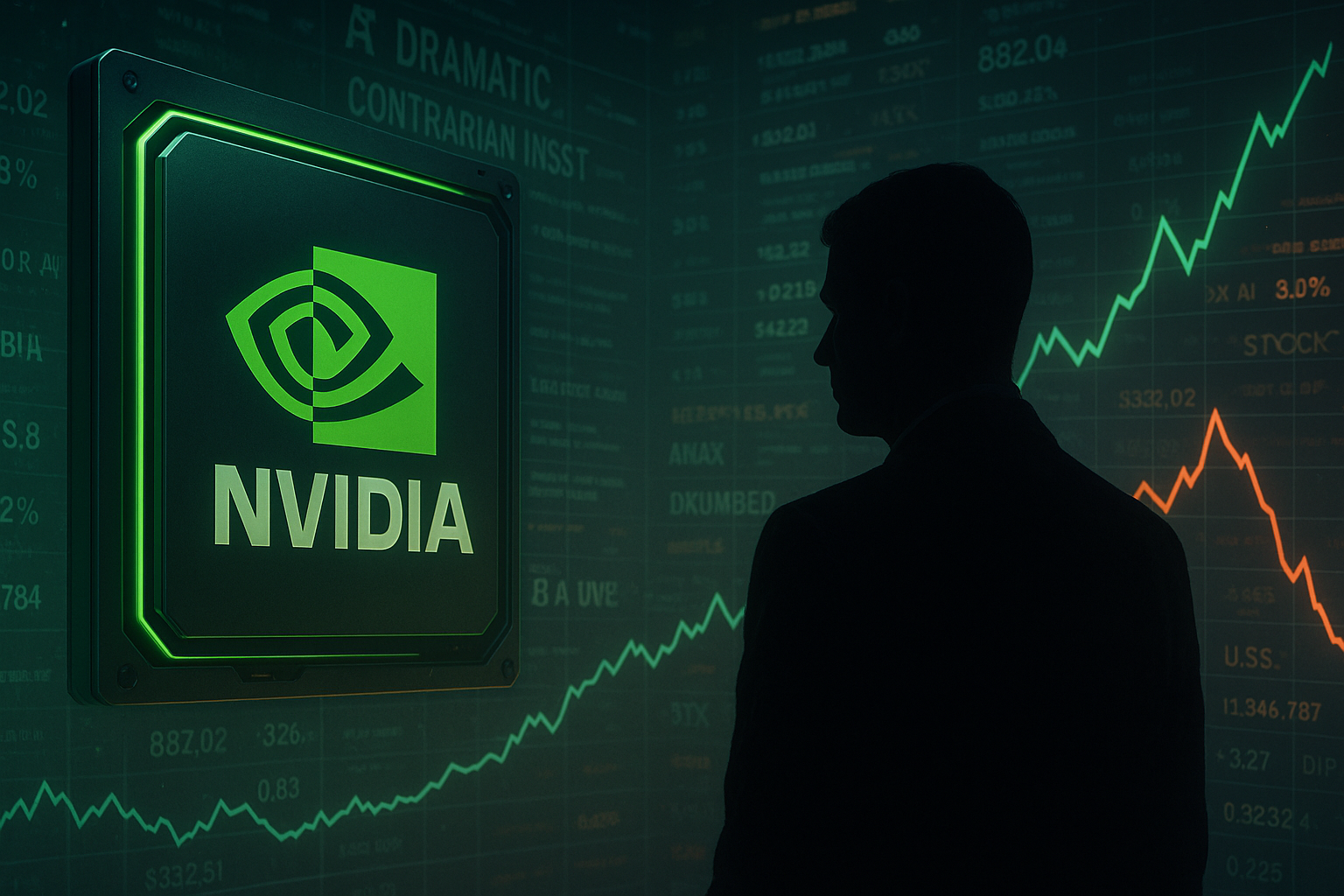
Nvidia stock was modestly lower in early trading on Tuesday as the chipmaker failed to claw back some of the losses suffered in the previous session, with investor attention centred on its recently disclosed agreement involving artificial-intelligence chip company Groq.
Nvidia shares were down 0.5% at $187.22 in early Tuesday trading after slipping 1.2% on Monday.
The stock’s slight stabilisation came amid broader mixed moves in the semiconductor space, with Advanced Micro Devices down 0.1% and Broadcom up 0.2%.
Groq deal in docus
The company-specific driver for Nvidia continues to be the market reaction to its recently announced agreement to secure a non-exclusive license for technology from privately held Groq.
According to a report by The Wall Street Journal, Nvidia is paying $20 billion for access to Groq’s technology, a figure that includes compensation packages for many of Groq’s key employees who are expected to join Nvidia as part of the arrangement.
The size and structure of the deal have drawn scrutiny. Early reporting, including an initial account by CNBC, described the transaction as an acquisition.
However, Groq later clarified that the agreement is a non-exclusive licensing deal combined with a talent transfer, rather than a full corporate takeover.
That distinction has contributed to uncertainty among investors and analysts attempting to assess the long-term financial and strategic implications.
Analysts highlight inference opportunity
Despite questions around valuation, some analysts see strategic merit in the agreement.
Mizuho analyst Vijay Rakesh said the deal strengthens Nvidia’s position in the fast-growing market for inference chips, which are used to run artificial intelligence models after they are trained.
Rakesh estimated that inference currently accounts for between 20% and 40% of AI workloads, a share he expects to rise to 60% to 80% over the next five years.
“We see this deal as a benefit to Nvidia in the long-run as it adds key IP [intellectual property] to its engineering team to build its inferencing capabilities,” Rakesh wrote in a research note.
He reiterated an Outperform rating on Nvidia and maintained a $245 price target.
Mizuho also noted that inference efficiency is increasingly critical for driving returns on massive AI infrastructure investments.
Nvidia, the firm said, has already demonstrated strong execution, with revenue reaching $187.14 billion and growing 65.22% over the past twelve months.
Still, the price tag has raised eyebrows. The Wall Street Journal reported that Groq had been projecting revenue of $1.4 billion in 2026, up from about $500 million this year and roughly $90 million in 2024, citing people familiar with the company’s financials.
That growth profile has prompted debate over whether the $20 billion commitment is justified.
Rising competitive pressures
The debate around Nvidia’s next phase of growth is unfolding against a backdrop of rising global competition.
Reports from the South China Morning Post last week said researchers from Shanghai Jiao Tong University and Tsinghua University have developed a photon-based computing chip known as LightGen, which they claim can outperform traditional silicon-based processors in certain AI training and inference tasks.
Separately, Meta Platforms announced Tuesday that it has agreed to acquire Manus, an AI startup originally founded in China and now based in Singapore, in a deal valued at around $2.5 billion.
Manus has said its general AI agent surpasses OpenAI’s Deep Research capabilities.
These developments underscore growing investor unease around the sustainability of returns from massive AI-related capital spending.
Nvidia shares are down about 8% over the past two months, while Microsoft has fallen 10% and Meta has dropped 11.8%.
Declines among smaller players have been steeper, with Oracle down 28% and AI cloud provider CoreWeave falling more than 45%.
The post Nvidia stock remains under pressure: what’s hurting the AI darling? appeared first on Invezz