












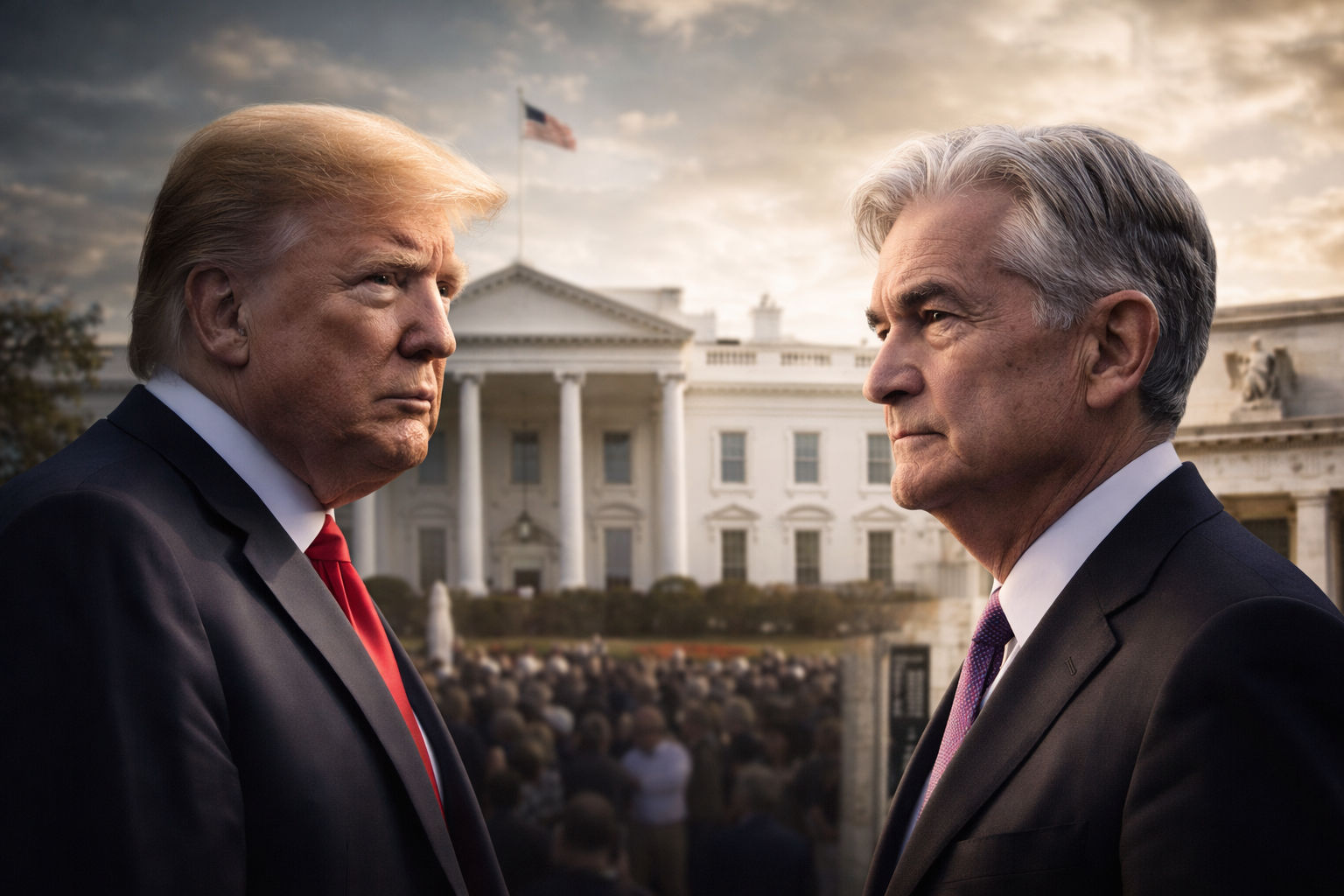
The approach of 2026 is sharpening attention on one of the most consequential decisions in US economic policy: who will lead the Federal Reserve after Jerome Powell’s term ends in May.
President Donald Trump has said he plans to announce his choice early next year, bringing to a head months of public criticism of Powell over interest rates and the central bank’s reluctance to ease policy more aggressively.
Trump’s frustration with Powell has been a recurring theme of his presidency, with the president repeatedly arguing that lower rates are needed to boost growth, markets and employment.
The looming transition now raises deeper questions about the Fed’s independence and the credibility of monetary policy at a time when inflation has cooled, but the labour market is showing signs of strain.
Why the new Fed chair will walk the razor’s edge
The White House has made little secret of what it wants in a successor.
Trump has said he is looking for a chair who will be more receptive to his views, a stance that has unsettled investors and economists who see central bank independence as critical to economic stability.
That concern was captured by Andy Laperriere, head of US policy research at Piper Sandler, who told the New York Times that whoever takes the job risks being “damaged goods”.
“You’re either going to be the guy who succeeds in getting what the president wants, which will not bode well for your treatment in the history books,” Laperriere said, “or you’re going to be the guy who doesn’t get what the president wants, and he’s going to probably turn on you.”
Markets have taken note. Analysts warn that if the Fed chair is perceived as beholden to political pressure, borrowing costs could rise rather than fall, undermining the very goal Trump is pursuing.
Top four contenders and the odds backing them
Trump told the Wall Street Journal last week that he was leaning toward either Kevin Hassett, his White House economic adviser, or former Fed governor Kevin Warsh.
Prediction markets reflect a tight race. Kalshi puts Warsh’s odds at about 47% and Hassett’s at 40%, while Polymarket shows similar probabilities.
Current Fed governor Chris Waller trails far behind, with single-digit odds.
BlackRock’s (BLK) head of fixed income, Rick Rieder, is also one of the candidates and will be interviewed by Trump in the last week of the year.
Other names have faded. Fed governor Michelle Bowman is no longer considered a contender, while Treasury Secretary Scott Bessent, long rumoured to be Trump’s preferred choice, has repeatedly declined interest in the role.
Kevin Hassett: loyalist under scrutiny
Kevin Hassett, 63, brings deep academic credentials, including a PhD in economics and earlier service on the Fed staff in the 1990s.
He later joined the American Enterprise Institute, where he focused on tax policy and supply-side economics, before becoming a prominent figure in Trump’s economic team.
Hassett has argued there is ample room for rate cuts, pointing to strong productivity growth and what he sees as higher potential GDP growth.
“I think there is plenty of room to do it … With productivity growth plus capital stock growth, you’re looking at like underlying potential GDP growth that’s way north of three, maybe north of four,” he said at the Wall Street Journal CEO Council on December 8, 2025.
In recent weeks, Hassett has found himself responding to growing scrutiny over his closeness to the president.
In an interview with CBS News on Sunday, he said that while he would hear Trump’s views on interest rates, they would carry no influence over his decisions.
“The Federal Reserve’s independence is really, really important, and the voices of the other people at the [Federal Open Market Committee], they’re important, too,” he said in an interview with CNBC.
“So the way you’ve got to drive interest rate movements is with consensus based on the facts and the data.”
Still, detractors question his effectiveness as head of the National Economic Council, arguing that he has played more of a messaging role than a policy-driving one.
That has fuelled doubts about whether he is equipped to lead the central bank during a sensitive phase for the economy.
Kevin Warsh: critic turned contender
Kevin Warsh, 55, appears to have momentum.
A former Fed governor with close ties to Republican circles, he has advised billionaire investor Stanley Druckenmiller and is affiliated with Stanford University’s Hoover Institution.
Trump has said Warsh is at the top of his list, though he has stopped short of a final decision.
“Yes, I think he is,” Trump told The Wall Street Journal when asked if Warsh was at the top.
Warsh has been a vocal critic of the Fed in recent years, calling for sweeping reform and warning that the central bank has expanded its reach too far, particularly through its balance sheet and engagement with issues such as climate change and inclusion.
He has also embraced a more dovish stance lately, arguing that rates can be lowered significantly without reigniting inflation.
“We can lower rates a lot and, in so doing, get 30-year fixed-rate mortgages so they’re affordable … Lower interest rates with the kind of technology revolution the president’s policies have permitted, the massive investment that’s happening in the economy domestically and from foreigners, this is the seed corn for our productivity revolution,” Fox Business reported on October 24, 2025.
That shift has raised eyebrows, given that Warsh was warning about inflation risks as recently as last year.
Support from figures such as JPMorgan chief executive Jamie Dimon has bolstered his standing, but critics say his calls for “regime change” lack concrete detail.
Chris Waller: the technocrat option
Chris Waller, 66, stands apart from the political jockeying.
A long-time academic and former research director at the St. Louis Fed, Waller joined the Fed’s Board of Governors in 2020 as a Trump appointee.
He has built a reputation for grounding his views in data and theory rather than ideology.
Waller was among the officials who pushed for rapid rate hikes in 2022 to combat inflation, and more recently has supported rate cuts as evidence of labour market cooling has mounted.
He has said rates could fall by 50 to 100 basis points if inflation continues to ease.
Unlike Hassett and Warsh, Waller has not argued that the Fed is fundamentally partisan, though he has expressed concern about mission creep.
His technocratic approach may appeal to markets, but his limited political profile could count against him in a White House seeking loyalty.
Rick Rieder: outsider with slim odds
Rick Rieder, BlackRock’s chief investment officer for global fixed income, represents the outsider option.
He oversees $2.4 trillion in assets and has experience advising public institutions, including the US Treasury and the Fed.
Rieder has consistently argued that the economy is normalising and that rate cuts are appropriate, aligning broadly with Trump’s views.
However, his chances remain slim, with prediction markets assigning him odds of around 2%.
While he has not been as openly critical of the Fed as some other contenders, his acknowledgement that tariffs could add to inflation may complicate his appeal.
A decision with lasting consequences
Whoever Trump chooses will inherit a Fed at a delicate juncture.
Inflation has eased from its peaks, but remains a concern, while the labour market is weakening and political scrutiny is intensifying.
The credibility of US monetary policy may hinge as much on perceptions of independence as on the direction of rates themselves.
As the decision approaches, investors, policymakers and the public will be watching closely, aware that the choice of the next Fed chair could shape the economy long after the current political cycle ends.
The post Who’s in line for the Fed’s top job? Leading contenders and what you need to know about them appeared first on Invezz