


















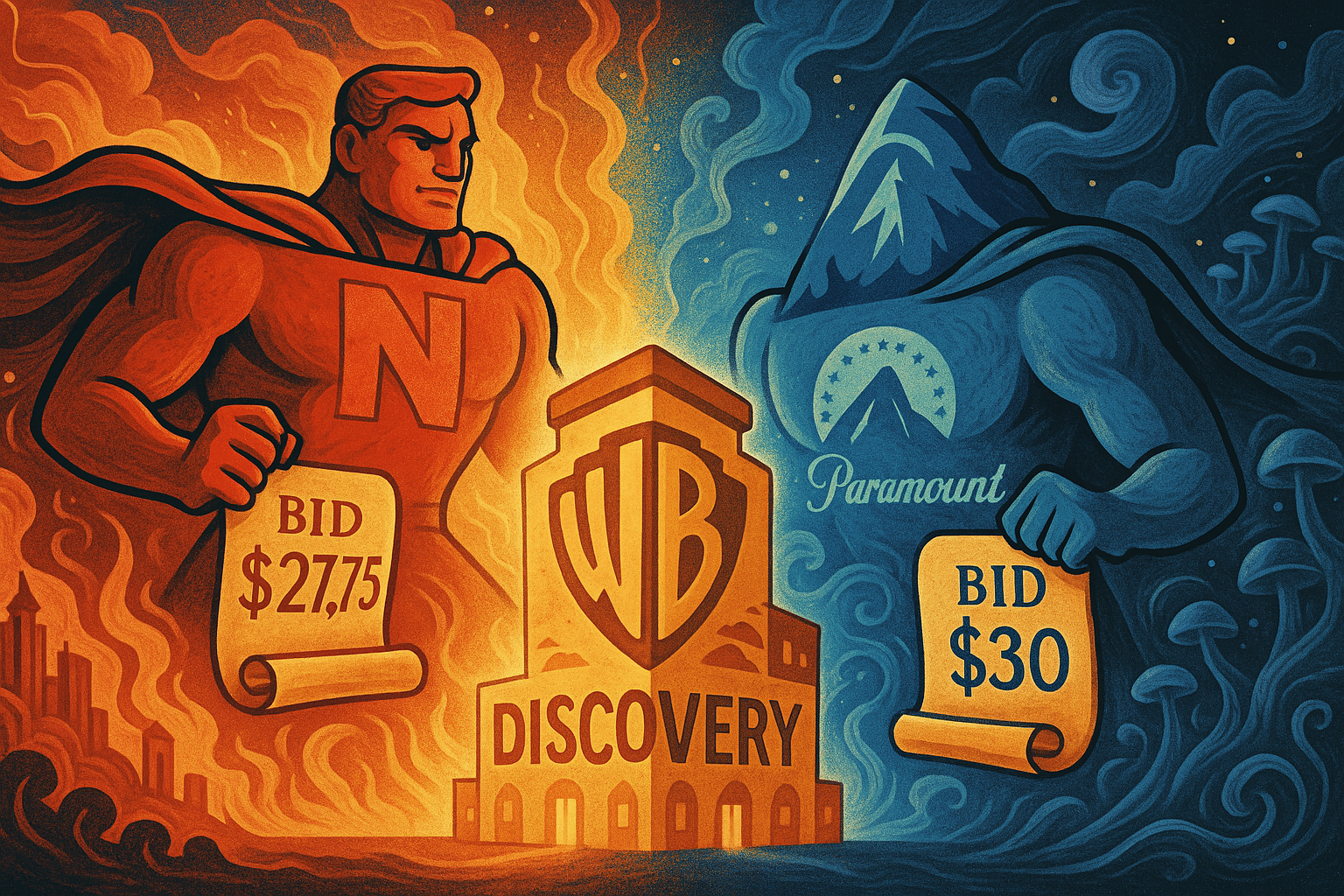
Warner Bros. Discovery on Wednesday recommended that shareholders reject an unsolicited takeover proposal from Paramount, escalating the high-stakes battle for control of the media group.
In a sharply worded letter, the board said the offer raised serious concerns about funding certainty and accused Paramount’s backers, Larry and David Ellison, of repeatedly misleading investors about the strength of the financing behind the deal.
“As a Board, we have now conducted another review and determined that PSKY’s tender offer remains inferior to the Netflix merger. The Board continues to unanimously recommend the Netflix merger, and that you reject the PSKY offer and not tender your shares,” WBD’s letter to shareholders said.
The board said it had been clear throughout discussions that any credible offer would require a full and unconditional financing commitment from the Ellison family.
What is Warner’s concern about the funding structure?
At the heart of Warner Bros. Discovery’s objection is the lack of a direct Ellison family commitment to the proposed $40.65 billion equity cheque.
Paramount, which is controlled by the Ellisons, has said its proposal includes a full backstop, but Warner Bros. Discovery said that was not the case.
“PSKY has consistently misled WBD shareholders that its proposed transaction has a “full backstop” from the Ellison family. It does not, and never has,” said the letter by WBD to shareholders.
“Instead, they propose that you rely on an unknown and opaque revocable trust for the certainty of this crucial deal funding. Despite having been told repeatedly by WBD how important a full and unconditional financing commitment from the Ellison family was – and despite their own ample resources, as well as multiple assurances by PSKY during our strategic review process that such a commitment was forthcoming – the Ellison family has chosen not to backstop the PSKY offer,” the letter said.
The letter also highlighted that the trust’s liability for damages would be capped at just 7% of its commitment, or about $2.8 billion on a transaction valued at more than $108 billion.
Warner Bros. Discovery said the potential harm to shareholders if the deal collapsed would likely far exceed that amount.
The board added that Paramount’s balance sheet and credit profile raised further concerns, pointing to high leverage levels and limited free cash flow generation if the deal were to close.
“Additionally, PSKY contemplates $9 billion in synergies from the mergers of Paramount/Skydance and their offer for WBD. These targets are both ambitious from an operational perspective and would make Hollywood weaker, not stronger,” WBD told shareholders.
The letter also called Paramount’s offer “illusory”.
“The offer can be terminated or amended by PSKY at any time prior to its completion; it is not the same thing as a binding merger agreement.”
WBD’s endorsement of Netflix’s offer
Warner Bros. Discovery contrasted Paramount’s bid with what it described as a superior and fully negotiated merger agreement with Netflix.
According to the company, the Netflix deal requires no equity financing and is backed by a public company with a market capitalisation of more than $400 billion and an investment-grade balance sheet.
Netflix, in a letter to WBD shareholders, said its financing structure is clean and certain, with committed debt financing from major institutions and no reliance on revocable trusts, personal loans or foreign sovereign wealth funds.
The company has also submitted regulatory filings and said it expects to close the deal within 12 to 18 months.
Netflix highlighted its $5.8 billion reverse termination fee, the largest of its kind in a public M&A deal, as evidence of its confidence in securing regulatory approvals in the United States and Europe.
How do analysts view the latest development
Analysts broadly said Warner Bros. Discovery’s rejection of Paramount Skydance’s offer reflects genuine concerns over deal certainty, even as the competing proposals carry different regulatory risks.
Jeffrey Wlodarczak, chief executive of Pivotal Research Group, said Warner’s board had valid reasons to favour Netflix’s bid, which he described as firm and fully backed by a deep-pocketed buyer.
“The WBD concerns over the PSKY offer are legitimate given the Netflix offer is firm and backed by a massive company with significant ability to add leverage,” Wlodarczak said.
He added that the Paramount Skydance proposal appeared less secure, noting that it is not directly backed by the Ellison family and could potentially be withdrawn.
However, Wlodarczak cautioned that regulatory scrutiny could tilt the balance.
He said Paramount’s offer would likely face fewer antitrust hurdles than a Netflix merger, which is expected to undergo intense review.
He added that Netflix could still clear regulators by modifying the deal, such as divesting assets like HBO while maintaining short- to medium-term content arrangements.
Paolo Pescatore, analyst at PP Foresight, described Warner’s stance as a clear vote of confidence in Netflix’s ability to execute.
“This is a strong endorsement of Netflix’s offer and its future ability to execute as a combined entity,” Pescatore said.
He added that Netflix’s proposal appeared to offer a better overall balance of value and regulatory certainty, calling it “the path of least resistance”.
Jonathan Kees, senior research analyst at Daiwa Capital Markets, said the battle is likely to escalate into a prolonged public and shareholder fight.
“It likely will become a media and proxy spectacle with each side presenting their case to shareholders, as well as to the press,” Kees said.
He expects the dispute to culminate at Warner Bros. Discovery’s next shareholder meeting, likely in early summer 2026.
Kees noted that institutional investors control about 73% of Warner Bros. Discovery’s shares, with Vanguard, BlackRock and State Street among the largest holders.
While such investors often consider proxy advisory recommendations, he said they do not always follow them automatically.
Despite the controversy, Kees said he believes Paramount Skydance’s financial backing remains sufficient, even if some high-profile supporters step away, underscoring that the outcome will ultimately hinge on shareholder sentiment and deal execution.
What options does Paramount have now?
Paramount, which submitted six proposals for Warner Bros. Discovery over a 12-week period, will now have to consider its next move, including the possibility of increasing its offer.
Under the terms of Warner Bros. Discovery’s agreement with Netflix, the company is barred from actively seeking rival bids.
Paramount, however, could still choose to sweeten its proposal and put it directly to Warner Bros. Discovery for consideration.
If Warner Bros. Discovery were to abandon the Netflix transaction in favour of another bidder, it would be required to pay Netflix a $2.8 billion break fee.
Netflix, for its part, could also respond to any renewed approach from Paramount by improving its own offer.
Despite the board’s recommendation, Paramount can still take its case directly to Warner Bros. Discovery shareholders.
Pescatore said the latest developments leave Paramount Skydance in a weakened position.
“The ball is now firmly in Paramount Skydance’s court to significantly raise its offer,” Pescatore said, however, adding that even a higher bid may not overcome the board’s concerns.
The offer could include launching a public campaign, sending materials to investors or increasing its offer to make it more attractive.
If Paramount were able to persuade a majority of shareholders to tender their shares, it could gain control even without board support.
Any improved offer would force Warner Bros. Discovery’s board to reassess its position.
Analysts have said a shareholder vote is unlikely to take place before April, leaving room for further manoeuvring in the coming months.
To revive its chances, Wlodarczak said Paramount Skydance would likely need to remove the revocable trust structure, abandon its hostile approach, increase its offer to account for Netflix’s break-up fee, and agree to a higher termination penalty of its own.
How could politics and regulation shape the outcome?
Regulatory scrutiny looms over both proposals, but Paramount has argued its bid would face fewer antitrust hurdles than a tie-up with Netflix, which already dominates global streaming.
The White House is expected to play a role in shaping how aggressively regulators examine either deal.
The Ellison family is an ally of President Donald Trump, and Paramount’s backers include Gulf sovereign wealth funds.
Trump has said he is not close to either bidder but has suggested Netflix’s proposal could raise competition concerns, adding another layer of uncertainty to an already complex takeover fight.
The post Why Warner Bros Discovery prefers Netflix’s offer over Paramount’s hostile bid appeared first on Invezz