



















India’s latest industrial figures show a sharp loss of momentum at the start of the festive quarter, raising new questions about how seasonal holidays, shifting trade conditions, and recent tax changes are reshaping factory activity.
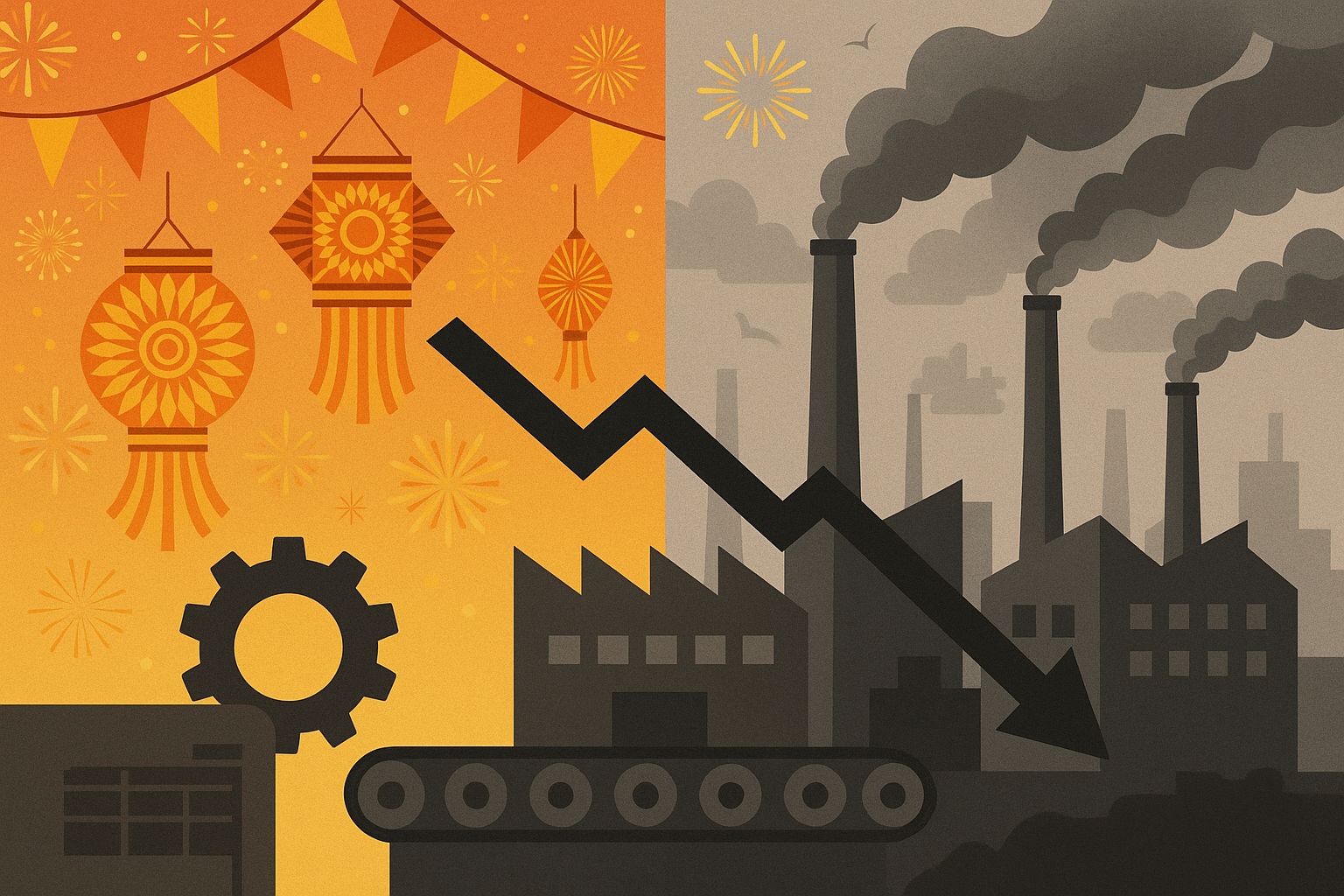
Industrial production grew only 0.4% in October, marking a 14-month low and signalling a clear break from the stronger pace seen in earlier months.
The slowdown came even as domestic consumption strengthened after a goods and services tax cut took effect on September 22.
October is usually a crucial period for businesses, but multiple festivals compressed the number of working days, affecting output across key sectors and weighing on overall growth.
October’s industrial performance was constrained by reduced operational days linked to Dussehra and Deepawali.
The Ministry of Statistics & Programme Implementation cited this shorter working period as a major factor behind the softer reading, which is now the weakest since August 2024.
The Index of Industrial Production rose only 0.4%, well below the 4% expansion recorded in September.
Manufacturing and energy sectors lose pace
Sector-level data showed clear weakness across India’s industrial system.
Manufacturing output rose 1.8% in October compared with 4.8% in September, pointing to slower activity despite improved consumer demand following the GST reduction.
Mining activity contracted 1.8%, while electricity generation fell 6.9%, signalling a wider pullback in industrial energy use.
These declines highlight how the disruption from festival schedules affected both production processes and energy requirements.
Policy shifts and global pressures shape demand
The weaker IIP reading came at a time when New Delhi has been using GST reductions to bolster domestic consumption and offset external risks, including a 50% US tariff on Indian goods.
Despite these challenges, the economy expanded faster than expected in the quarter ending September.
Domestic consumption improved across major consumer categories after the September tax cut, offering some support to manufacturers even as export demand softened.
Experts expect consumption trends to play an important role in the months ahead.
While export weakness is likely to persist between October and December, stronger household spending, lower inflation, reduced interest rates, and recent tax relief are expected to keep demand stable.
At the same time, government capital expenditure may slow between October and March as authorities work to manage the fiscal deficit amid subdued tax collections.
Core industries and festive inventory cycles
The IIP tracks short-term changes across a broad set of industrial products, with eight core industries such as steel, cement, electricity, and fertiliser making up 40% of the index’s weight.
These sectors form the backbone of India’s industrial base, and their performance often sets the direction for the overall index.
In September, industrial growth held at 4% as businesses increased inventory in preparation for the five-day festive season in October.
This early stock build-up helped support activity before the holiday period, but production slowed once the festivals began and operational days fell.
The post India industrial slowdown deepens as festival season disrupts production appeared first on Invezz